Satellite communications (SATCOM) are entering a pivotal decade shaped by bandwidth-hungry applications, hybrid 5G-NTN architectures, and the operational need for efficiency, uptime, and spectral cleanliness. At the heart of this transformation lies the high-power amplifier (HPA).
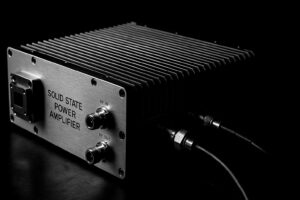
For years, Travelling Wave Tube Amplifiers (TWTAs) set the pace in uplink power. Today, Gallium Nitride (GaN) Solid State Power Amplifiers (SSPAs) are redefining what operators can demand from their ground segment: high linearity across wider bandwidths, energy efficiency that compounds at network scale, hot-swap modularity, and predictable MTBF for mission-critical services.
This paper examines the market and technology context for the shift from tube-based HPAs to GaN SSPAs—with a practical focus on Ku-band (13.75–14.5 GHz) and DBS-band (17.3–18.4 GHz) broadcast/uplink systems—then outlines how engineering choices in amplifier architecture, thermal design, redundancy, and control software translate into measurable business outcomes for teleport operators, broadcasters, government/defense, and scientific missions.
Celestia TTI contributes to this new baseline with high-power GaN SSPA families—including Ku-600W and DBS-550W—engineered for multicarrier uplinks, phase-combined scalability, and robust outdoor/indoor deployments.

1. Why HPA Technology Matters More Than Ever
1.1 Traffic Growth, Modulation Complexity, and Uplink Headroom
Traffic growth is not only about more megabits; it is about more dense constellations of carriers and higher-order modulations (e.g., 32APSK/64APSK where applicable) that demand stringent linearity and low error vector magnitude (EVM) from the uplink chain. The HPA determines how much of the link budget survives after real-world impairments—AM/AM and AM/PM conversion, temperature dynamics, and spectral regrowth under multicarrier operation.
1.2 Energy, Sustainability, and OPEX
Ground stations increasingly face energy constraints and ESG accountability. Every percentage point of HPA efficiency cascades through power distribution and HVAC. Replacing TWTAs with GaN SSPAs reduces warm-up time, shrink standby overhead, and improves thermal predictability—lowering total cost of ownership (TCO).
1.3 Reliability, Maintainability, and SLA Commitments
Media networks, teleports, and defense links design for five-nines availability. GaN SSPAs provide instant-on behavior, no consumable cathodes, and hot-swappable modules in redundant configurations, simplifying maintenance windows and minimizing mean time to repair (MTTR).
2. From TWTA to GaN SSPA: What Changes and Why It Matters
2.1 Power Density and Efficiency
GaN enables higher power density at microwave frequencies than legacy GaAs and removes the fragile, consumable elements of TWTs. In practical terms, operators can achieve equivalent or higher saturated and linear output power with less rack space and lower cooling penalties—crucial in remote outdoor hubs or compact indoor head-ends.
2.2 Linearity and Multicarrier Behavior
Modern SATCOM uplinks rarely operate at a single carrier near saturation. They run multicarrier back-off, where linearity dominates. GaN SSPAs—with optimized Doherty/combining stages and digital predistortion (where applicable)—deliver clean shoulders under multicarrier load, enabling operators to preserve spectral mask compliance without over-provisioning.
2.3 Availability and Lifecycle
TWTAs demand filament warm-up, suffer cathode wear, and behave differently as tubes age. GaN SSPAs are solid-state: they start instantly, follow thermal controls deterministically, and support module-level redundancy (N+1/1:1, soft-fail). Over a five- to seven-year horizon, this yields fewer service interruptions and clearer spares planning.
2.4 Safety and Handling
Removing high-voltage tube supplies simplifies site safety, training, and spares logistics. Field teams replace identical power modules on the fly rather than keeping tube types and HV components in inventory.
Bottom line: The performance envelope of GaN SSPAs directly translates to more predictable services, lower OPEX, and greater link agility as bandwidth plans and customer mixes change.
3. Ku-Band and DBS-Band Applications
3.1 Ku-Band (13.75–14.5 GHz)
Ku-band remains the workhorse for VSAT enterprise, maritime, government, and video contribution/distribution. Antenna sizes remain manageable, link budgets are well-understood, and carrier density keeps rising. HPAs must deliver high linear output across multicarrier transponders, with tight gain-flatness to protect complex modulations.
3.2 DBS-Band (17.3–18.4 GHz)
DBS uplinks prioritize broadcast stability and spectral cleanliness. Network planners value dedicated broadcast spectrum and consistent EIRP across service footprints. An HPA in this band must handle continuous high duty cycles, phase noise constraints, and steady thermal loading over long events and 24/7 DTH operations.
Celestia TTI addresses both regimes with GaN SSPA families that combine high linearity, robust thermal design, and phase-combining scalability—specifically Ku-600W for high-power Ku uplinks and DBS-550W for DBS broadcast applications.
4. Engineering the Modern HPA: Key Features
4.1 RF Architecture and Combining
- Wideband gain stages matched for flatness across the band (Ku/DBS) to reduce per-carrier equalization
- Phase combining options to scale from single-chassis operation to higher EIRP without re-architecting feeds
- Back-off linearity engineered for multicarrier operation—the real-world regime for teleports
4.2 Thermal Design and Environmental Robustness
- High-efficiency heat-sinks and intelligent fan curves to stabilize junction temperatures
- Outdoor-rated enclosures (when ODU) for deserts, maritime ports, and high-altitude sites
- Predictable thermal behavior protects EVM, ACLR, and spectral mask performance over diurnal cycles
4.3 Redundancy, Soft-Fail, and Hot-Swap
- 1:1 and N+1 topologies with soft-fail logic: a degraded module triggers controlled derating or automatic switchover
- Hot-swappable power modules maintain RF output while field personnel replace faulty units—shrinking MTTR
- Diverse PSU inputs and surge protection for harsh grids and genset operation
4.4 Control, Telemetry, and Diagnostics
- IP-based control with SNMP/REST for NMS integration, plus local/remote GUIs for field ops
- Predictive health metrics: bias drift, temperature gradients, fan RPM deltas, PSU headroom
- Alarm granularity fine enough to dispatch the right spare to the right site—no guesswork
4.5 Electromagnetic Compatibility and Spectral Purity
- Compliance with spectral masks under worst-case carrier packs
- Low phase noise and AM/PM stability to protect adjacent services
- Optional linearization/predistortion for dense broadcast multiplexes
5. GaN SSPA vs TWTA: A Practical Decision Matrix
| Criterion | GaN SSPA (e.g., Ku-600W / DBS-550W) | TWTA (Modern Tube) |
|---|---|---|
| Start-up & Warm-up | Instant-on | Warm-up required |
| Linearity @ Back-off | High linearity for multicarrier | Good single-carrier, careful management multicarrier |
| Maintenance | Modular, hot-swap, no tubes | Tube wear, HV supplies, scheduled tube changes |
| Efficiency & Heat | Higher wall-plug efficiency; predictable cooling | Lower efficiency; higher heat per W linear |
| Redundancy | Fine-grained module redundancy (1:1/N+1) | Coarser redundancy; swap whole unit |
| Lifecycle/OPEX | Favorable over 5–7 years | Higher consumables & HVAC cost |
| Safety | No HV tube supplies | HV handling and training |
Outcome: For most teleport, broadcast, and gov/def uplinks that operate multicarrier with strict SLAs, GaN SSPA offers clear operational advantages and compounding OPEX savings.

6. Celestia TTI Product Focus: Ku-600W and DBS-550W
6.1 Ku-600W GaN SSPA — High-Power Ku for Dense Carrier Plans
Use cases: Video distribution/contribution, enterprise VSAT hubs, maritime gateways, government links.
Highlights:
- High linear output power across 13.75–14.5 GHz with excellent gain flatness, minimizing external EQ
- Phase-combined scalability: grow EIRP by adding modules, not redesigning the RF room
- Soft-fail redundancy and hot-swappable modules to sustain on-air availability
- Intelligent control/telemetry: remote diagnostics, trend analytics, and API integration
- Compact ODU/IDU options for constrained sites and retrofits
6.2 DBS-550W GaN SSPA — Broadcast-Grade Stability in DBS Band
Use cases: DTH broadcast uplinks, 24/7 multiplexes, live events contribution.
Highlights:
- Linear power optimized for 17.3–18.4 GHz with low spectral regrowth under multicarrier
- Thermal stability for long-duration continuous load—consistent MER and mask compliance
- Module redundancy to avoid service interruptions in prime-time windows
- Control plane aligned with broadcast NMS workflows; secure remote operation
Both product families are engineered around GaN efficiency, reliability, and serviceability, with a lifecycle approach that reduces energy and maintenance overheads while preserving link performance.
7. Integration with 5G and Non-Terrestrial Networks (NTN)
7.1 Hybrid Architectures Need Hybrid-Ready HPAs
As 5G networks expand into NTN domains, the ground segment must support advanced waveforms and tight phase/amplitude stability to preserve end-to-end QoS. HPAs sit at the edge of this integration, where signal integrity is won or lost.
7.2 Carrier Aggregation and Spectral Hygiene
GaN SSPAs must sustain clean shoulders under carrier aggregation and dynamic carrier adds/removals. Teleports can then scale services without resetting back-off margins or risking adjacent-channel interference.
7.3 Automation and Closed-Loop Control
Telemetry-rich HPAs enable closed-loop control with the NMS: power tracking, temperature-aware gain, and alarm-driven switchover, reducing human-in-the-loop risk in 24/7 operations.
8. Applications and Deployment Patterns
8.1 Broadcast & Media
- Multicarrier multiplexes require excellent ACLR/EVM to keep pictures clean and avoid spectral fines
- Live events benefit from instant-on HPAs with soft-fail pathways—no dead air
- Regional redundancy: N+1 aggregation across multiple racks/ODUs protects national feeds
8.2 Government & Defense
- ISR and tactical links need predictable startup and survivability in harsh environments
- Mobility (land-sea-air) favors compact, efficient ODUs with robust environmental sealing
- Security posture improved by eliminating HV subsystems and simplifying spares
8.3 Teleports & Gateways
- Dense carrier farms leverage phase-combined SSPAs to raise EIRP without re-plumbing waveguide trees
- Predictive maintenance from telemetry trends: swap a degrading module at the right time, not in the middle of prime time
- Energy optimization: reduced HVAC load improves PUE for the RF hall
8.4 Scientific & Deep-Space
- Telemetry and precision timing benefit from low phase noise and thermal stability
- Long-duration sessions demand HPAs with steady linearity and no warm-up drift
9. Sustainability and the Ground Segment
9.1 Efficiency at Scale
A seemingly modest improvement in wall-plug efficiency yields a material OPEX reduction when multiplied across racks and years. Less heat means smaller HVAC demand and lower carbon intensity per transported bit.
9.2 Repairability and Lifecycle
Modular SSPAs extend useful life: upgrade a module; don’t scrap an enclosure. Spare pools are simpler (identical modules), and e-waste is reduced.
9.3 Site Footprint and Noise
Quiet, compact GaN HPAs enable denser RF rooms and smaller shelters, particularly valuable in remote uplink sites and urban teleports with strict noise/space constraints.

10. Procurement and ROI: What Decision-Makers Should Model
10.1 Five-Year TCO Model Inputs
- Acquisition: HPA chassis, combining hardware, controller, spares
- Energy: kWh at typical back-off in local tariff bands
- Cooling: Incremental HVAC cost from HPA heat load
- Maintenance: Planned module swaps vs tube replacements; labor hours; travel
- Downtime Risk: SLA penalties; ad revenue at risk; mission costs
10.2 Sensitivities
- Carrier density growth over time (more back-off headroom needed)
- Ambient temperature ranges at site
- Redundancy level (1:1 vs N+1) and mean time to service access
- Spare module logistics vs tube lead times
Well-engineered GaN SSPAs typically show a favorable ROI when accounting for energy + HVAC + maintenance + downtime avoidance—not merely capex.
11. Migration Playbook: From Tube-Based to GaN SSPA
Step 1: Audit the Uplink
Map carriers, back-off, spectral masks, headroom, HVAC capacity, and control interfaces.
Step 2: Select Target Power Class
Choose Ku-600W or DBS-550W (or phase-combined variants) to meet linear power requirements with growth room.
Step 3: Plan Redundancy
Decide 1:1 or N+1 based on SLA and operational model; position spare modules accordingly.
Step 4: Control/NMS Integration
Validate SNMP/REST objects, alarms, and dashboards.
Step 5: Phased Cutover
Start with non-critical transponders, validate shoulder masks/EVM, then migrate prime multiplexes.
Step 6: Train Field Ops
Hot-swap procedures, alarm interpretation, and basic diagnostics.
Step 7: Monitor & Tune
Use telemetry trends to set proactive maintenance cadence and confirm energy deltas.
12. Frequently Asked Technical Questions
Q1: How much back-off should I reserve for multicarrier linearity?
It depends on carrier count, PAPR, and mask limits. As a rule, size the SSPA for linear power at your worst-case carrier plan, not just saturated specs. GaN SSPAs like Ku-600W and DBS-550W are engineered to preserve ACLR/EVM at practical back-off levels for dense multiplexes.
Q2: Can I phase-combine to reach higher EIRP without re-architecting the room?
Yes. Phase Combined Systems allow modular scaling. Start with a baseline SSPA, then add modules to meet new footprints or programming peaks.
Q3: What happens on module failure during an on-air event?
Soft-fail redundancy maintains output through automatic derating or switching; the failed module is hot-swapped without taking the service down.
Q4: Will I need special HVAC changes?
Typically less than with tubed systems due to higher GaN efficiency and better thermal predictability. Validate with site thermal audits.
Q5: Is there a risk of RF performance drift over time?
GaN SSPAs exhibit stable behavior; the control plane monitors bias/thermal parameters and can alert on trends before they impact RF metrics.
13. Strategic Outlook: The Next Five Years
- Denser carrier packs and higher-order modulations will continue to raise the linearity bar
- LEO/MEO backhaul and NTN 5G will push ground systems to behave like software-defined networks, increasing the value of telemetry-rich, API-driven HPAs
- Sustainability will shape procurement as power and cooling dominate OPEX
- GaN process improvements and smarter combining will keep lifting linear W-per-rack while simplifying field operations
Conclusion: The market is standardizing on GaN SSPA for high-power uplinks. Operators who transition now will bank compounding efficiency gains, simplify maintenance, and unlock capacity for new services without re-wiring their RF rooms every budget cycle.
14. About Celestia TTI
With more than two decades building RF and microwave systems for broadcast, SATCOM, government/defense, and scientific missions, Celestia TTI delivers GaN-based SSPAs that combine high linear power, phase-combined scalability, soft-fail redundancy, and intelligent control. The Ku-600W and DBS-550W families distill these engineering choices into practical, service-ready systems for teleports and broadcasters planning for the next decade of growth.
Key Solution Themes:
- High linear output for multicarrier uplinks in Ku and DBS bands
- Phase Combined Systems for scalable EIRP
- Soft-fail + hot-swap to maintain on-air commitments
- Energy-efficient GaN design to reduce OPEX and footprint
- Telemetry and control aligned to 24/7 operations and NMS integration