Satellite test systems for Galileo navigation programmes depend on ensure that Europe’s flagship positioning constellation delivers precise and reliable services to billions of users worldwide. As the programme advances toward its second generation, demand for advanced verification infrastructure continues to grow. Every spacecraft and ground facility must undergo rigorous validation before entering operational service.
These testing protocols confirm that navigation payloads, uplink stations, and control systems meet the strict accuracy requirements defined by the European Space Agency. Moreover, the complexity of modern GNSS constellations demands testing solutions that evolve alongside the technology they validate.
Satellite Test Systems For Galileo Navigation: Architecture and Scope
Constellation Design and Core Services
The Galileo constellation represents Europe’s independent global navigation satellite system. Currently, it serves over four billion smartphone users with metre-scale positioning accuracy. The system operates through a carefully coordinated infrastructure comprising space, ground, and user segments. Twenty-six first-generation satellites occupy three orbital planes at approximately 23,222 kilometres above Earth. Each spacecraft carries highly precise atomic clocks that generate the timing signals essential for positioning calculations.
Furthermore, the constellation supports multiple service tiers tailored to different user communities. Open Service provides free positioning to civilian users worldwide. The Public Regulated Service offers encrypted, jam-resistant signals for government and defence applications. Additionally, the Search and Rescue service relays distress signals from emergency beacons to rescue coordination centres within minutes. The High Accuracy Service delivers centimetre-level precision for professional applications such as surveying and precision agriculture.
The second generation of Galileo satellites introduces fully digital navigation payloads, electric propulsion, and inter-satellite link capacity. These advancements demand sophisticated satellite test systems for Galileo navigation verification campaigns can address. As capabilities increase, testing complexity grows proportionally across every segment of the programme.

Evolution from First to Second Generation
Galileo Second Generation satellites will integrate seamlessly with the current fleet to form the largest European satellite constellation. With improved navigation antennas and advanced atomic clock configurations, these spacecraft will deliver decimeter-scale precision positioning. Consequently, the test infrastructure must validate performance improvements that exceed previous generation specifications by significant margins. Navigation satellite EGSE must adapt to verify new digital payload architectures while maintaining backward compatibility with existing signal formats. Consequently, next-generation satellite test systems Galileo navigation infrastructure must support both legacy and advanced signal architectures simultaneously.
Critical Satellite Test Systems For Galileo Navigation Challenges
Timing and Synchronization Testing
Atomic clock performance verification represents the most demanding aspect of Galileo payload testing. A clock error of just one nanosecond translates into a positioning error of approximately 30 centimetres. Therefore, GNSS testing equipment must achieve measurement accuracies well beyond those required in conventional satellite programmes. Modern satellite test systems Galileo navigation teams operate characterize hydrogen maser and rubidium clock stability over multiple time intervals with exceptional precision.
Short-term stability measurements assess Allan deviation at one-second intervals. Long-term drift analysis extends across days or weeks to identify gradual degradation trends. Additionally, synchronization testing verifies that each satellite maintains precise time alignment with the Galileo System Time reference. Ground-based test equipment generates simulated timing signals that replicate operational conditions with nanosecond-level fidelity. These simulators inject known errors to validate the satellite’s ability to detect and compensate for anomalies automatically.
In particular, the test infrastructure must verify inter-satellite synchronization for the second-generation constellation. Inter-satellite links enable direct time transfer between spacecraft without ground station involvement. This capability requires dedicated test configurations that simulate the complete orbital geometry and signal propagation environment.
Signal Quality Verification
Navigation signal integrity directly determines positioning accuracy for end users across all Galileo services. Consequently, signal quality verification encompasses multiple critical parameters. Test systems measure signal power levels, spectral purity, code modulation accuracy, and carrier phase stability. Each measurement must fall within tolerances defined by the Galileo Signal-In-Space Interface Control Document.

Modern navigation satellite EGSE employs software-defined radio architectures for flexible signal analysis. This approach enables rapid reconfiguration between different Galileo signal types, including E1, E5a, E5b, and E6 bands. Furthermore, multipath simulation capabilities allow engineers to assess signal performance under realistic propagation conditions. Signal authentication testing has become increasingly important as a safeguard against spoofing threats targeting civilian receivers.
Additionally, test campaigns must verify signal compatibility with other GNSS constellations. Galileo signals coexist with GPS, GLONASS, and BeiDou transmissions in shared frequency bands. Interference testing confirms that navigation messages maintain integrity even in congested electromagnetic environments. These compatibility assessments require sophisticated satellite test systems Galileo navigation engineers rely on, including advanced RF simulation equipment capable of generating multiple constellation signals simultaneously.
Galileo Ground Segment Test Solutions
Redundancy Testing Procedures
The Galileo ground segment encompasses uplink stations, control centres, and monitoring networks distributed across multiple continents. Each facility requires validated equipment to maintain constellation performance continuously. Comprehensive satellite test systems Galileo navigation ground segment solutions must address both individual station verification and integrated system validation. Celestia Technologies Group provides dedicated satellite test and simulation systems for EGSE applications that support these demanding requirements across all mission phases.
Galileo’s ground infrastructure implements multiple layers of redundancy to guarantee uninterrupted service delivery. Accordingly, redundancy testing verifies seamless failover between primary and backup systems at every critical point. Test scenarios simulate equipment failures across the complete signal chain. This includes antenna feed switches, frequency converters, power amplifiers, and baseband processing units.
Hot standby configurations require particular attention during validation campaigns. The transition between active and standby equipment must occur without measurable impact on navigation message transmission. Moreover, ground stations supporting Galileo operations integrate turnkey satellite ground station infrastructure for mission-critical programmes designed for continuous, uninterrupted service. Redundancy testing also covers software failover in monitoring and control systems that manage station operations remotely.
End-to-End Validation
End-to-end validation confirms that the complete signal chain functions correctly from ground station to satellite and back to user receivers. This process requires dedicated satellite test systems Galileo navigation campaigns use to simulate the full operational environment under controlled conditions. Hardware-in-the-loop configurations place actual equipment within simulated signal paths to identify interface issues before deployment.
Validation campaigns typically proceed through several structured stages. Initial testing verifies individual equipment performance against detailed specifications. Integration testing then confirms correct operation between connected subsystems. Finally, system-level validation exercises the complete ground station under realistic operational scenarios. These campaigns often involve coordination with the Galileo Control Centre to verify command and telemetry interfaces across the network.
In contrast to unit-level testing, end-to-end validation reveals emergent behaviours that only appear when subsystems interact. Timing offsets, protocol mismatches, and signal degradation through cascaded processing stages become visible only at system level. Therefore, comprehensive end-to-end testing remains essential even when individual components pass standalone verification successfully.
Uplink Station Equipment and ULS Testing
Advanced Phased Array Technology for Galileo Uplink
Galileo uplink stations transmit critical navigation data to the constellation continuously. This data includes orbit determination parameters, clock correction values, and integrity information essential for positioning accuracy. The quality of uplink transmissions directly affects performance for all users worldwide. Consequently, ULS testing demands exceptionally rigorous verification protocols that validate every element of the transmission chain.
Traditional uplink stations rely on mechanically steered dish antennas to track individual satellites sequentially. However, next-generation ULS configurations incorporate phased array technology for significantly enhanced operational capability. Multi-beam phased array antenna systems for Galileo satellite tracking enable simultaneous communication with multiple spacecraft without mechanical movement or handover interruptions.

ESA’s research and development programme funded the development of advanced phased array antennas specifically for Galileo ULS applications. Each antenna panel contains nearly 1,500 individual transmission elements working in precise coordination. During ULS testing, engineers must verify beam steering accuracy, sidelobe suppression, and simultaneous multi-satellite tracking performance under operational conditions. Furthermore, specialized baseband modems for Galileo ULS signal generation produce the navigation messages transmitted through these advanced antenna systems.
Power Amplification and RF Chain Verification
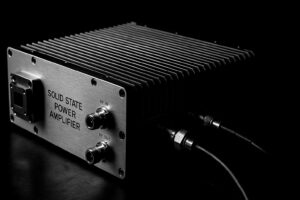
Uplink power amplification represents another critical element in the ULS signal chain. High-power GaN solid state amplifiers designed for satellite uplink stations deliver consistent output across demanding operational conditions and extended transmission periods. ULS testing protocols verify power stability, spectral mask compliance, and thermal management throughout continuous operation cycles.
These amplifiers must maintain precise output characteristics to ensure navigation message integrity reaches each satellite. RF chain verification encompasses the complete path from modem output through frequency conversion, amplification, and antenna transmission. Notably, any degradation in the uplink signal directly compromises the accuracy of navigation corrections broadcast to users. Test equipment must detect performance variations well below operational thresholds to prevent service impact.
Additionally, electromagnetic compatibility testing ensures that high-power transmissions do not interfere with sensitive receive equipment co-located at the same ground station. Isolation measurements between transmit and receive chains confirm that uplink signals do not contaminate the monitoring receivers used to verify constellation health.
Quality Assurance for Satellite Test Systems For Galileo Navigation Programmes
Compliance with ESA Standards
Quality assurance in Galileo programmes follows structured frameworks established by the European Space Agency and the European Commission. Every satellite test systems Galileo navigation facility deploys must demonstrate traceability, repeatability, and documented compliance before operational deployment. These requirements extend beyond the satellite itself to encompass all ground-based test and operational equipment throughout the programme lifecycle.
ESA’s European Cooperation for Space Standardization framework defines specific requirements for test equipment used in institutional programmes. Satellite test systems for Galileo navigation must comply with ECSS-E-ST-10-03 for testing procedures and ECSS-Q-ST-20 for quality assurance requirements. These standards mandate comprehensive documentation of test configurations, calibration procedures, and measurement uncertainties for every verification activity.
Modern EGSE platforms enabling efficient satellite test campaigns incorporate automated documentation features that streamline compliance significantly. Test sequences automatically generate reports with full traceability to requirements baselines. Calibration management systems track instrument certification status and schedule recalibration before expiry dates. Additionally, configuration control ensures that test setups remain consistent and reproducible across repeated verification campaigns spanning months or years.
Environmental Qualification and Operational Readiness
Environmental qualification testing verifies that ground equipment operates reliably under the conditions encountered at operational sites worldwide. Temperature cycling, humidity exposure, and electromagnetic compatibility testing confirm equipment robustness across diverse environments. For stations located across multiple continents, qualification must cover the full range of expected climatic conditions.
Operational readiness reviews assess whether satellite test systems Galileo navigation facilities use and associated ground equipment meet all prerequisites for mission support. These reviews examine staff training, documentation completeness, spare parts availability, and maintenance procedures. As a result, they provide formal confirmation that the ground segment can support constellation operations safely and effectively. The structured approach to quality assurance ensures that every component in the Galileo infrastructure meets the high standards required for a critical navigation service.
Similarly, periodic revalidation campaigns confirm that equipment performance remains within specification throughout its operational lifetime. Degradation monitoring identifies components approaching end-of-life before they affect service quality. This proactive approach minimizes unplanned downtime and maintains the availability levels essential for a safety-of-life navigation system.
Looking for proven test infrastructure and ground equipment for your next satellite navigation programme? Celestia TTI and the Celestia Technologies Group deliver end-to-end solutions with decades of experience supporting ESA institutional missions including Galileo.
Ground station solutions |
Phased array antennas |
SSPA power amplifiers |
EGSE testing solutions