The rapid expansion of Low Earth Orbit satellite constellations has fundamentally changed the landscape of space communications. From broadband internet providers deploying thousands of spacecraft to Earth observation companies building imaging networks, operators face unprecedented challenges in maintaining reliable contact with their orbital assets. At the heart of every successful constellation lies a critical component that often goes unnoticed: the telemetry, tracking, and command modem.
Unlike traditional geostationary satellites that remain fixed relative to ground stations, LEO spacecraft race across the sky at velocities exceeding 7 kilometers per second. This constant motion creates a demanding operational environment where communication windows last mere minutes, signal frequencies shift continuously due to Doppler effects, and ground systems must seamlessly hand off between satellites. The TT&C modem serves as the essential bridge between ground operators and their spacecraft, translating commands into radio signals and decoding vital health data streaming down from orbit.
Modern constellation operators cannot afford communication failures. A single missed command window might delay critical maneuvers, while unreliable telemetry could mask developing problems until they become catastrophic. This reality has driven significant advances in modem technology, pushing manufacturers to develop solutions that combine exceptional reliability with the flexibility needed to support hundreds or thousands of individual spacecraft.
LEO constellation operations challenges
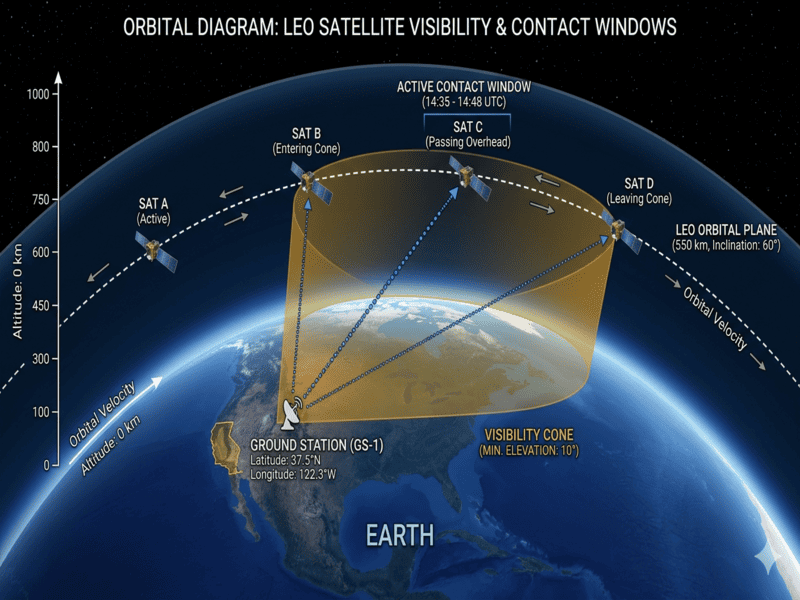
Operating a LEO constellation presents a unique set of technical hurdles that distinguish it from traditional satellite missions. The fundamental challenge stems from orbital mechanics: spacecraft at altitudes between 400 and 2,000 kilometers complete a full orbit every 90 to 120 minutes, creating brief contact opportunities with any given ground station.
Visibility windows typically last between 5 and 15 minutes, depending on orbital altitude and ground station location. During this short period, operators must establish link acquisition, verify spacecraft health through telemetry downloads, upload any pending commands, and confirm successful execution before the satellite disappears below the horizon. This compressed timeline leaves no room for equipment malfunctions or communication errors.
The high angular velocity of LEO satellites compounds these difficulties. Ground antennas must continuously track spacecraft moving at apparent speeds of several degrees per second near the horizon. Any tracking error degrades signal quality, potentially corrupting critical data or causing complete link loss. Modem systems must maintain lock despite rapidly changing signal conditions while compensating for the geometric effects of this constant motion.
Constellation scale introduces additional complexity. Where traditional operators might manage a handful of spacecraft, modern constellations can number in the hundreds or thousands. Each satellite requires individual attention, yet ground infrastructure costs must remain manageable. This economic pressure drives demand for modems capable of supporting multiple simultaneous contacts and rapid reconfiguration between different spacecraft.
Environmental factors also play a significant role. LEO satellites pass through the South Atlantic Anomaly and polar radiation zones, occasionally causing bit errors or temporary system upsets. Ground equipment must distinguish between genuine anomalies requiring operator intervention and transient effects that will resolve naturally. Intelligent filtering and robust error correction become essential features rather than optional enhancements.
TT&C modem requirements
The demanding LEO environment imposes strict requirements on TT&C modem design. Performance specifications that might be considered adequate for geostationary missions often prove insufficient when applied to fast-moving, frequently contacted constellation spacecraft.
Doppler compensation techniques
Perhaps no requirement better illustrates the LEO challenge than Doppler shift compensation. As a satellite approaches a ground station, transmitted frequencies appear higher than their nominal values. As it recedes, frequencies shift lower. For a typical LEO orbit, these shifts can reach ±40 kHz at S-band frequencies or even higher at X-band and Ka-band.
Modern TT&C modems employ sophisticated algorithms to predict and compensate for these frequency variations. The most capable systems combine orbital ephemeris data with real-time signal analysis, continuously adjusting local oscillator frequencies to maintain optimal demodulation performance. This dynamic compensation must occur smoothly to avoid introducing phase discontinuities that could disrupt coherent communication modes.
Advanced implementations feature closed-loop Doppler tracking that refines predictions based on actual received signals. This approach proves particularly valuable during early mission phases when orbital elements may contain residual errors, or following maneuvers that alter the predicted trajectory.
Ranging and timing
Accurate range measurement supports multiple critical functions in constellation operations. Beyond basic orbit determination, precise ranging enables collision avoidance calculations, formation flying coordination, and payload timing synchronization.
TT&C modems generate ranging measurements by embedding timing markers in the uplink signal and measuring the round-trip delay of corresponding downlink responses. Modern systems achieve ranging accuracies of a few meters, sufficient to support most operational requirements. For missions demanding higher precision, specialized ranging modes using regenerative techniques can push accuracy into the centimeter regime.
Timing synchronization presents related challenges. Many constellation payloads require precise knowledge of absolute time to correlate observations or coordinate activities across multiple spacecraft. The TT&C modem often serves as the conduit for distributing timing information, either through dedicated timing signals or by providing accurate epoch markers in the telemetry stream.
High-Reliability design principles
Mission-critical space operations demand equipment that functions flawlessly under all conditions. TT&C modem manufacturers have developed comprehensive design approaches that minimize failure probability while ensuring graceful degradation if problems do occur.
Command encryption
Security considerations have become increasingly important as satellite systems integrate into critical infrastructure. TT&C modems must prevent unauthorized command transmission while ensuring legitimate operators retain reliable spacecraft access.
Modern security architectures employ multiple layers of protection. Authentication mechanisms verify that commands originate from authorized sources, while encryption prevents eavesdropping on sensitive telemetry. Key management systems enable periodic credential updates without requiring physical access to orbiting assets.
The challenge lies in implementing robust security without compromising operational flexibility. Emergency situations may require rapid response, potentially involving personnel or facilities not normally authorized for spacecraft control. Well-designed security systems accommodate these contingencies through carefully structured override procedures that maintain accountability while enabling necessary actions.
Redundancy configurations
Hardware redundancy provides the foundation for high-reliability operations. Critical modem subsystems typically employ dual-redundant architectures where backup units can assume control within milliseconds of detecting a primary failure.
Beyond simple duplication, sophisticated redundancy schemes consider failure modes and their operational impacts. Hot standby configurations maintain backup units in an active state, ready for immediate switchover. Cold standby approaches keep backup units powered down, reducing wear but requiring longer activation times. The optimal choice depends on mission requirements and acceptable risk levels.
Cross-strapping between redundant chains adds another layer of protection. If multiple components fail across different functional areas, cross-strapping allows operators to construct working signal paths from surviving elements. This capability proves particularly valuable for long-duration missions where cumulative failures might otherwise exhaust simple redundancy.
CCSDS standards compliance
The Consultative Committee for Space Data Systems has developed comprehensive standards governing space communication protocols. Adherence to these standards ensures interoperability across missions, ground networks, and international partners while incorporating decades of operational experience.
CCSDS-compliant modems support standardized packet structures, coding schemes, and modulation formats. This standardization enables constellation operators to leverage existing ground infrastructure, potentially sharing antenna time with other missions rather than building dedicated facilities. The economic benefits can be substantial, particularly for smaller operators who cannot justify exclusive ground station ownership.
Protocol standards extend beyond basic signal formats to encompass file transfer mechanisms, time distribution methods, and security frameworks. A fully compliant TT&C modem integrates seamlessly with standard ground system software, reducing development costs and accelerating operational readiness.
Compliance verification involves rigorous testing against reference implementations. Major space agencies maintain test facilities where manufacturers can validate their equipment against standardized test cases. This independent verification provides operators with confidence that claimed compliance reflects actual interoperability rather than marketing optimism.
Scalable solutions
Constellation economics demand ground segment architectures that scale efficiently as satellite counts grow. The marginal cost of supporting additional spacecraft must remain modest, or constellation business cases quickly become unviable.
Ground software integration
Modern TT&C modems function as networked devices within larger ground system architectures. Software interfaces enable automated operation, status monitoring, and configuration management through standard protocols.
Well-designed integration frameworks support multi-mission operations where a single ground station simultaneously serves multiple constellations. Automated scheduling systems allocate antenna time, configure modems for upcoming contacts, and archive resulting data without continuous human intervention. Operators focus on exception handling and long-term planning rather than routine contact execution.
Virtualization technologies are increasingly enabling software-defined approaches where modem functionality runs on commercial computing hardware. These architectures promise dramatic scalability improvements, potentially supporting hundreds of simultaneous contacts through appropriately sized processing clusters. While software implementations may not yet match purpose-built hardware in every performance dimension, the gap continues to narrow as processing capabilities advance.
Cloud-based deployment models extend these benefits further. Operators can provision modem capacity on demand, scaling resources to match actual contact schedules rather than peak theoretical requirements. This flexibility proves particularly valuable during constellation deployment phases when satellite counts change rapidly.
Leading manufacturers like Celestia-TTI are developing next-generation TT&C modem solutions that combine CCSDS compliance with the scalability and reliability features essential for modern constellation operations.
The LEO constellation revolution has transformed TT&C modem requirements from straightforward communication devices into sophisticated systems that must balance multiple competing demands. Doppler compensation, ranging precision, security, reliability, standards compliance, and scalability all factor into successful designs.
Operators evaluating modem solutions should consider their complete operational concept rather than focusing narrowly on individual specifications. A modem that excels at raw performance metrics but integrates poorly with ground software may prove less valuable than a slightly more modest system offering seamless automation support.
The technology continues evolving rapidly. Software-defined approaches promise greater flexibility, while advancing security threats drive continuous improvements in protection mechanisms. Operators who establish relationships with manufacturers committed to ongoing development position themselves to benefit from these advances without disruptive equipment replacements.
As constellations grow in size and economic importance, the humble TT&C modem will remain essential to their success, quietly enabling the reliable spacecraft operations that everything else depends on.