
The maritime industry has undergone a digital transformation that would have seemed impossible just a decade ago. Container ships stream real-time logistics data to shore-based operations centers. Cruise liners offer passengers broadband connectivity rivaling terrestrial hotels. Offshore platforms coordinate complex drilling operations through video links spanning thousands of kilometers. Behind this revolution lies a critical enabling technology: the electronically steered antenna.
Traditional mechanically steered satellite antennas have served the maritime sector for decades, but their inherent limitations increasingly constrain operational capabilities. Moving parts wear out, tracking accuracy degrades in heavy seas, and the physical bulk of stabilized pedestals consumes precious deck space. Electronically steered antennas overcome these constraints through solid-state beam steering that maintains satellite lock without mechanical motion.
The transition toward electronic steering reflects broader trends reshaping maritime communications. Multi-orbit satellite constellations demand antennas capable of tracking spacecraft across the entire sky hemisphere. Bandwidth requirements continue escalating as vessels adopt cloud-based systems, autonomous navigation technologies, and crew welfare applications. Meanwhile, operational economics pressure ship operators to reduce maintenance costs and maximize system availability.
For maritime communications professionals evaluating antenna technologies, understanding the capabilities and limitations of electronically steered systems has become essential knowledge. This examination covers the key considerations shaping maritime ESA selection, from fundamental technology choices through installation requirements and operational factors.
Maritime connectivity requirements
Modern maritime operations depend on reliable satellite connectivity that earlier generations of seafarers could scarcely imagine. Understanding these requirements provides essential context for evaluating antenna technologies.
Operational communications form the foundation of maritime connectivity needs. Navigation data, weather information, port coordination, and fleet management systems require consistent, low-latency connections that function regardless of vessel location. A container ship transiting the Pacific needs the same connectivity quality as one approaching Rotterdam, despite being thousands of kilometers from any terrestrial infrastructure.
Crew welfare applications have evolved from occasional email access to expectations approaching shore-side broadband. Streaming video, social media, voice calls, and video conferencing keep mariners connected with families during extended deployments. These applications drive bandwidth demands that strain traditional maritime satellite systems.
Safety communications impose non-negotiable reliability requirements. GMDSS compliance, emergency coordination, and medical consultation links must function when needed, without exception. Antenna systems supporting these services require redundancy and reliability exceeding typical commercial standards.
IoT and automation systems represent the fastest-growing connectivity category. Engine monitoring, cargo tracking, fuel optimization, and predictive maintenance systems generate continuous data streams requiring reliable uplink capacity. Emerging autonomous vessel technologies will further intensify these demands, requiring real-time control links that cannot tolerate connectivity interruptions.
The cumulative effect of these requirements creates bandwidth demands measured in tens or hundreds of megabits per second for large vessels. Meeting these demands reliably across global ocean routes pushes antenna technology to its limits.
ESA vs mechanical antenna systems
The choice between electronically steered and mechanically steered antennas involves fundamental tradeoffs that vary in importance across different maritime applications.
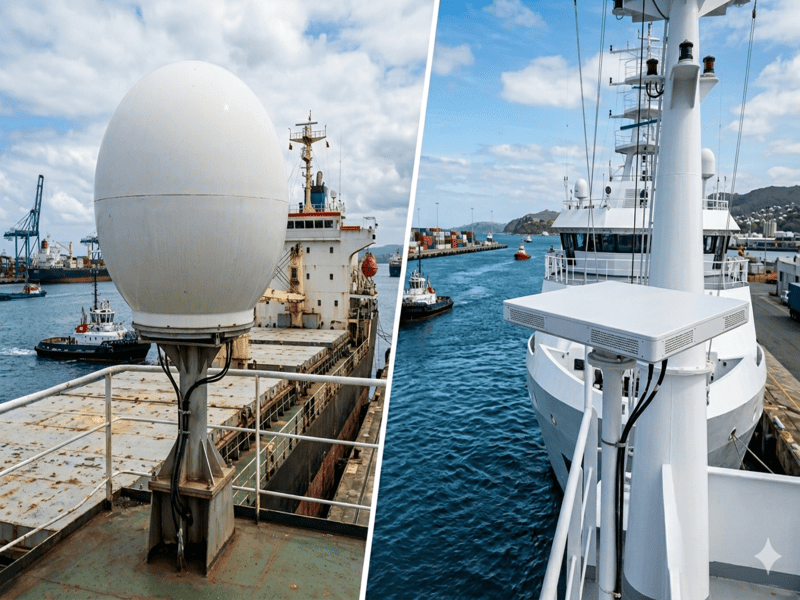
Mechanical antenna systems employ physical gimbals to point a parabolic reflector or phased array toward the target satellite. Stabilization systems counteract vessel motion, maintaining pointing accuracy despite pitch, roll, and yaw movements. These systems have demonstrated reliability over decades of maritime service, with well-understood failure modes and established maintenance procedures.
However, mechanical systems face inherent limitations. Moving parts wear over time, requiring periodic maintenance that may be difficult to perform at sea. Bearings, motors, and position sensors all represent potential failure points. Environmental exposure to salt spray, temperature extremes, and constant vibration accelerates degradation.
Tracking speed limitations affect mechanical systems during aggressive vessel maneuvers or severe sea states. The physical mass of antenna assemblies limits how quickly pointing can change, potentially causing signal loss during rapid motion events. Larger antennas, offering higher gain and throughput, face greater challenges due to increased moment of inertia.
Electronically steered antennas eliminate mechanical motion through solid-state beam steering. Thousands of individual antenna elements, each with electronically controlled phase and amplitude, combine to form beams steerable across wide angular ranges. No gimbals, no bearings, no motors—just semiconductor devices and control electronics.
The reliability advantages prove substantial. Without mechanical wear mechanisms, ESA systems can operate continuously for years without maintenance intervention. Mean time between failures extends dramatically compared to mechanical equivalents. For vessels operating in remote areas where technical support is unavailable, this reliability difference significantly impacts operational availability.
Profile and footprint benefits favor ESA systems for many installations. Flat panel configurations mount flush with deck structures, avoiding the radome protrusions characteristic of mechanical systems. Reduced height minimizes wind loading and visual impact, important considerations for yacht and cruise applications.
Multi-beam capability enables ESA systems to simultaneously track multiple satellites across different orbital positions. A single antenna can maintain links to both geostationary and LEO satellites, or switch rapidly between different GEO orbital slots. Mechanical systems require separate antennas for each simultaneous link.
Multi-orbit maritime solutions
The proliferation of satellite constellations across multiple orbital regimes creates both opportunities and challenges for maritime connectivity. ESA technology proves particularly well-suited to this multi-orbit environment.
Geostationary satellites have traditionally dominated maritime communications, offering consistent coverage and straightforward tracking requirements. GEO satellites remain stationary relative to Earth’s surface, simplifying antenna pointing to a single fixed direction. However, GEO systems face latency constraints that affect real-time applications, and polar coverage gaps limit service in high-latitude routes.
LEO constellations address these limitations through hundreds or thousands of satellites orbiting at altitudes between 500 and 1,200 kilometers. Lower altitude reduces latency to levels comparable with terrestrial networks. Inclined orbital planes provide coverage extending to polar regions. But LEO operation demands antennas capable of tracking rapidly moving satellites, executing frequent handoffs between spacecraft, and potentially maintaining multiple simultaneous links.
Motion compensation techniques
Maintaining satellite lock from a moving vessel requires sophisticated motion compensation that anticipates and counteracts ship movements. ESA systems implement this compensation electronically, adjusting beam pointing through phase control updates occurring thousands of times per second.
Inertial measurement units provide real-time attitude data enabling predictive beam steering. High-quality IMUs detect motion before it significantly affects pointing, allowing preemptive corrections that maintain link quality through maneuvers that would challenge reactive systems.
Adaptive algorithms continuously optimize beam patterns based on received signal quality. These algorithms adjust for factors beyond simple pointing, including atmospheric effects, interference, and satellite transponder variations. Machine learning techniques increasingly enhance these optimizations, learning vessel-specific motion patterns that improve prediction accuracy.
Seamless handoffs between LEO satellites require coordinating link termination on one spacecraft with link establishment on the next, without perceptible service interruption. ESA systems with multi-beam capability can maintain overlapping connections during transitions, ensuring continuous data flow even as active satellites change.
Installation and integration
Successful maritime ESA deployment requires careful attention to installation and integration factors that significantly impact system performance.
Environmental hardening
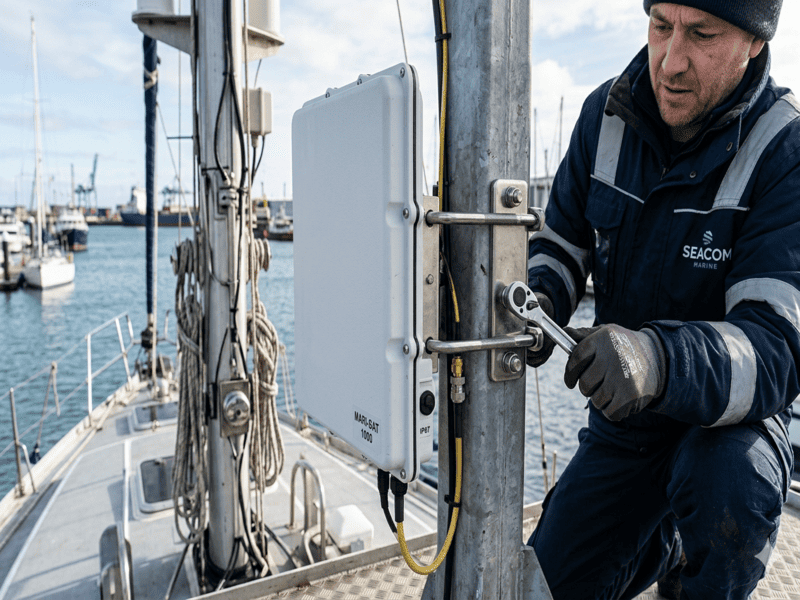
The marine environment subjects antenna systems to extraordinary environmental stresses. Salt spray continuously attacks metallic surfaces, promoting corrosion that degrades both structural integrity and RF performance. Temperature extremes range from tropical heat to arctic cold, imposing thermal cycling stresses on materials and electronics. Constant vibration and occasional shock loads from heavy weather test mechanical robustness.
Enclosure design must protect sensitive electronics while maintaining RF transparency. Radome materials resist UV degradation, withstand impact from rain, hail, and bird strikes, and remain electrically stable across environmental conditions. Sealing prevents moisture ingress that could cause immediate failures or accelerate corrosion of internal components.
Material selection throughout the antenna assembly reflects marine requirements. Stainless steel fasteners resist corrosion. Conformal coatings protect circuit boards. Cable assemblies employ marine-grade insulation and connectors. Manufacturers experienced in maritime applications understand these requirements; those adapting land-mobile or aviation products may overlook critical details.
Leading suppliers like Celestia-TTI engineer maritime antenna systems specifically for ocean environment demands, incorporating materials and construction techniques proven through extensive fleet deployments.
Mounting considerations affect both performance and longevity. Antenna placement must provide clear sky view toward relevant satellite positions while avoiding interference from shipboard structures. Mounting structures must withstand continuous vibration loading without fatigue failures. Isolation from hull flexing prevents stress transmission that could damage antenna components.
Operational considerations
Beyond initial installation, ongoing operational factors determine whether ESA systems deliver their potential benefits throughout extended service lives.
Bandwidth management
Satellite bandwidth remains expensive, making efficient utilization essential for operational economics. Intelligent bandwidth management systems allocate capacity dynamically based on application priorities and real-time demand patterns.
Traffic prioritization ensures critical operational communications receive necessary bandwidth even when recreational usage peaks. Quality of service mechanisms distinguish between latency-sensitive applications requiring immediate delivery and bulk transfers tolerant of queuing delays.
Compression and optimization technologies reduce bandwidth consumption without perceptibly degrading user experience. Video stream adaptation matches quality to available capacity. Web acceleration techniques minimize redundant data transmission. These optimizations extend effective capacity beyond raw bandwidth allocations.
Regulatory compliance
Maritime satellite operations occur within complex regulatory frameworks varying by geographic region, flag state, and service type. Antenna systems must comply with applicable regulations to ensure legal operation and avoid interference with other services.
Type approvals certify equipment compliance with technical standards established by national and international authorities. The approval process verifies that antenna systems meet emission limits, operate within allocated frequencies, and incorporate required safety features.
Operational licensing may impose geographic restrictions, power limitations, or reporting requirements specific to particular routes or operating areas. Compliance management systems track regulatory requirements across vessel itineraries, adjusting system parameters automatically when entering areas with different rules.
Hybrid connectivity solutions
Maximizing maritime connectivity often requires hybrid approaches combining satellite links with other technologies. Electronically steered antenna systems increasingly support integration with complementary connectivity options.
LTE and 5G connectivity provides high-bandwidth, low-latency links when vessels operate within range of coastal cellular infrastructure. Hybrid systems automatically shift traffic to terrestrial networks when available, reserving satellite capacity for open-ocean operations or backup.
WiFi mesh networks distribute connectivity throughout vessel interiors, connecting crew devices, operational systems, and IoT sensors to the satellite backhaul. Properly designed mesh architectures maintain seamless coverage despite the metallic construction that challenges wireless propagation aboard ships.
Software-defined networking enables intelligent traffic routing across available connectivity options. SDN controllers evaluate real-time link conditions, application requirements, and cost factors when selecting transmission paths. This dynamic optimization maximizes effective connectivity while minimizing operating costs.

Future outlook
The maritime ESA market continues evolving rapidly, driven by satellite constellation developments and advancing antenna technologies. Several trends will shape the coming decade.
LEO constellation maturity will shift maritime connectivity economics significantly. As Starlink Maritime, OneWeb, and other LEO services expand coverage and reduce pricing, demand for compatible ESA terminals will accelerate. Vessels will increasingly expect LEO-capable antennas as standard equipment rather than premium options.
Antenna integration with vessel systems will deepen. Future ESA terminals will connect directly with navigation systems, engine monitoring platforms, and operational software, enabling automated data flows without manual configuration.
Autonomous vessel requirements will drive development of ultra-reliable ESA systems capable of maintaining connectivity without human intervention. Control links for remotely operated or fully autonomous vessels cannot tolerate the connectivity interruptions acceptable for crewed ships.
Electronically steered antennas represent a fundamental advancement in maritime satellite communications, offering reliability, performance, and flexibility advantages that mechanical systems cannot match. As bandwidth demands escalate and multi-orbit connectivity becomes standard, ESA technology will increasingly dominate maritime installations.
Successful deployment requires attention to the complete system context: environmental hardening appropriate for ocean conditions, integration with shipboard networks and management systems, regulatory compliance across operating areas, and hybrid connectivity strategies that maximize value from available technologies.
Maritime operators evaluating antenna investments should consider not merely current requirements but anticipated evolution in connectivity needs. The vessels commissioned today will operate for decades, through technology transitions that will make current capabilities seem primitive. ESA systems with upgrade paths and multi-orbit flexibility position operators advantageously for this certain but unpredictable evolution.
The connected vessel has become operational reality rather than future vision. Electronically steered antennas make that connectivity reliable, maintainable, and economically sustainable across the world’s oceans.